





































Skip to content
Sign inBook a demo

Ethos forMigration Practices

One place for the truth about every matter.

From first enquiry to visa grant, and the next application after that. Intake, documents, dates, lodgement, Department correspondence and your professional obligations on one record. Ethos prepares. You decide and you lodge. Built in Australia, data stays in Australia.

You are the coordination layer between your tools.That was never the job.

A practice tool, a lodgement tool, ImmiAccount, a shared drive, an inbox, a marketing tool, accounting software and a calendar, as well as all your trusted sources like the Department website.

None of them talk to each other, so a person carries every piece of information across by hand, and everyone in the team keeps their own to-do list to be sure.

  • Everything comes back by email

    Department correspondence carries no matter reference.

  • Dates live in someone’s head

    Visa expiries tracked in a personal Outlook calendar.

  • Nobody trusts the status field

    Where a matter is really up to is worked out by opening folders.

  • Documents chased, named and checked by hand

    Your tools tell you what you have received. Nothing tells you what is missing.

Enter it once. Lodge it right.Every date watched.

Ethos is the same system governance and legal teams run on, configured for migration work.

A migration content pack, pathway by pathway, sits on top of matters, documents, dates, compliance, learning and a client view that already work together. Most of it needs no AI at all.

  1. A questionnaire per pathway, in the client’s language, with repeat clients’ answers already filled. Documents named to your convention on upload, ticked against the checklist for that subclass, and what is missing flagged on arrival, not at lodgement.

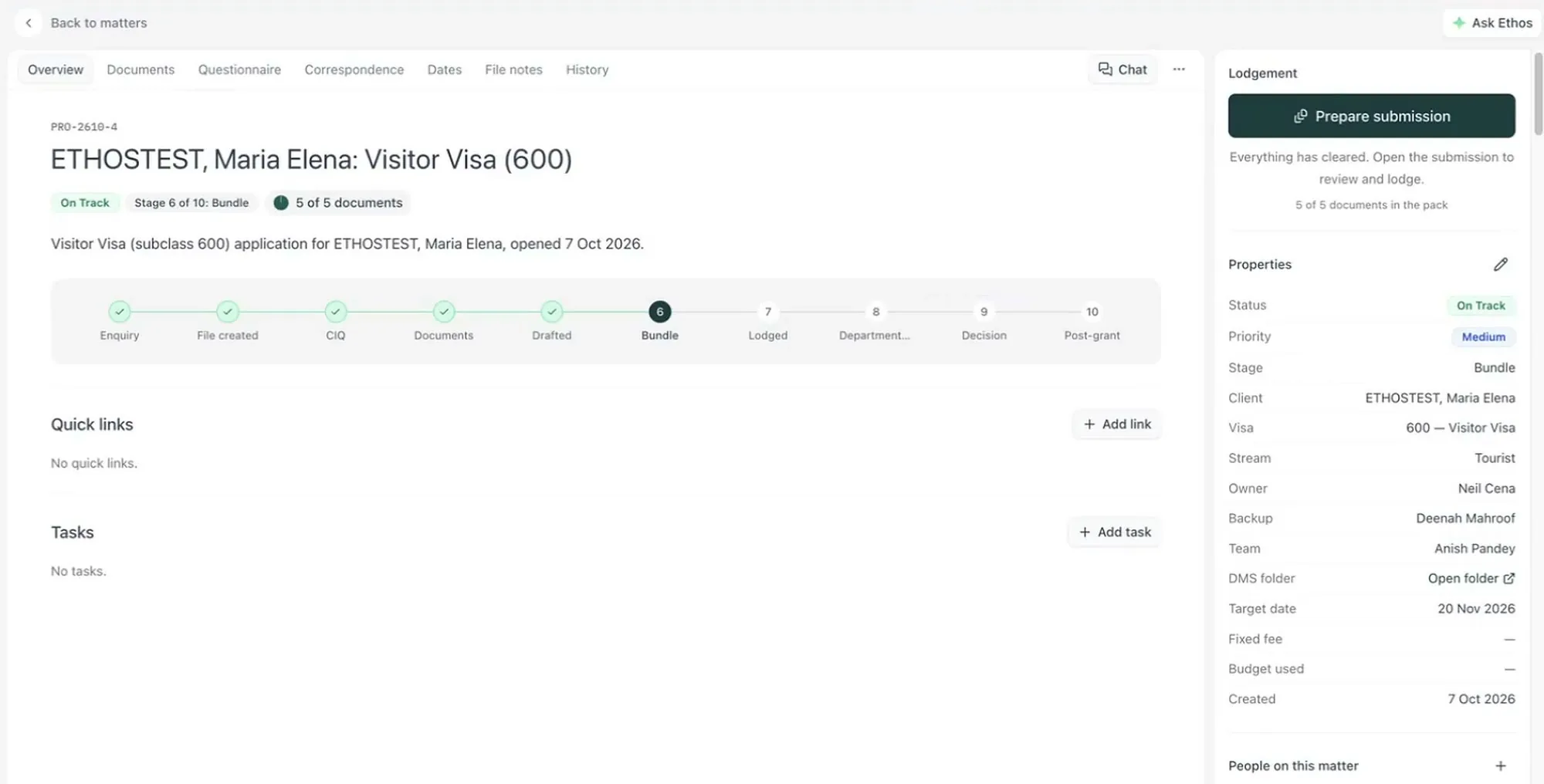
  2. Nomination and visa. Applicant and family. This visa and the next one. One record, with the relationships kept and the full history on it, so a handover is opening the matter.

  3. Home Affairs application forms drafted from what the client has already told you, and kept current as the Department changes them. Change an answer once and it changes everywhere.

  4. Ethos autofills the application forms and uploads the submission documents into ImmiAccount, ready for your review. You check each page, accept the terms and lodge. The lodgement record is saved to the matter.

  5. Department correspondence read, matched to the matter by application number, dates extracted, status updated. You confirm once. Five manual steps become one.

  6. Your clients check progress, what has been received and what is still needed in their own view, in plain English and in their language. Fewer “any update?” emails, and every message kept on the record.

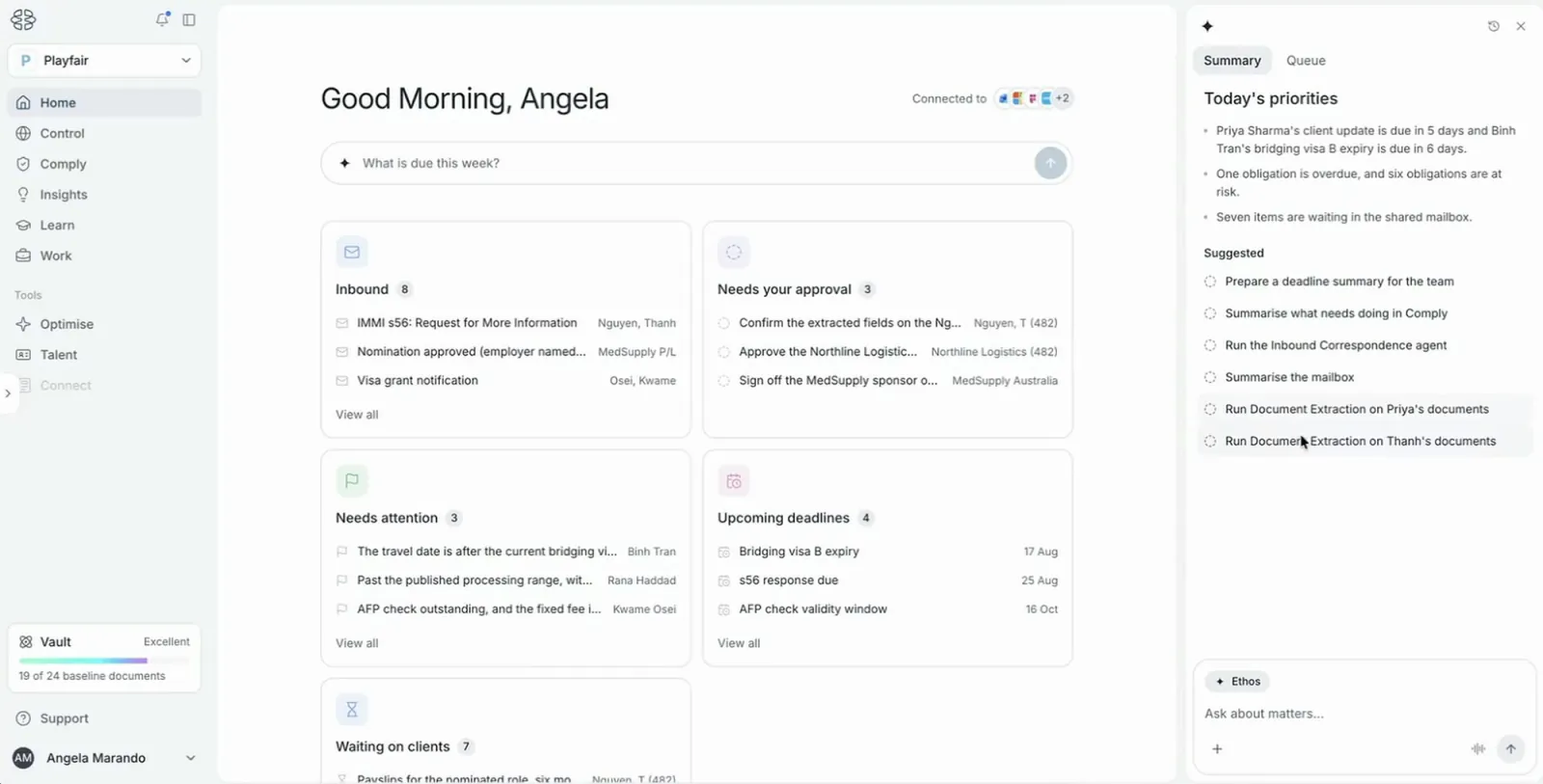
  7. Beside every matter, Ethos shows what needs attention now: the next date, the missing document, a time risk against the Department’s processing times, a regulatory change that touches this subclass. Worked out from the matter, your practice and your role, not a generic to-do list.

5 to 1

manual steps per Department email, before and after

25 to 33 hours

a week of admin a mid-sized practice can save using Ethos

39

migration pathways mapped

103

Home Affairs forms catalogued

10 minutes

to have your CPD tracker live

Every date watched, even when you are the only one watching.

Visa expiry cascades, bridging visa conditions, s48 bars, ART review windows, sponsor obligation checks and decision windows are computed from the matter record and surfaced 90, 60 and 30 days out, synced to your Outlook calendar.

Every date has a named backup, and lead-time alerts escalate if nobody acts.

Days since lodgement sit on every matter next to the Department’s current processing times, so the question “how long is this taking?” has a measured answer.

Nothing lodges itself.

Lodgement stays with the practitioner.

What Ethos does is take the form-filling, uploading and renaming out of it.

Application forms are autofilled from the matter record, subclass by subclass, and the submission documents are uploaded alongside them, for your review and oversight before anything is lodged.

You check, you accept the terms, you lodge, and your name stays where the regulators, OMARA and your Law Society, and your clients expect.

Start today on your own, or let Ethika set it up with you.

EssentialsSelf-Serve, from today

For registered agents and small practices, three steps to clarity.


  1. Sign up, add a payment method and go straight in.
  2. Answer a few set-up questions (your regime, the visa categories you work with, the communities you serve) and Ethos configures your pathways, checklists and CPD tracker.
  3. Connect Microsoft 365 and import your contacts and open matters, and you are working within the hour.

No call required, and we are here if you want one.

Book a demo

AI Intelligence (optional)

Professional and EnterpriseImplemented with you

For firms with a team, a document system and a lodgement tool to retire.


Ethika connects your Outlook, SharePoint or drive and your existing matter data, trains a handful of champions first and then the whole team, and stays with weekly check-ins until Ethos is genuinely used.

Weeks, not months.

Book a call and we will scope it on a matter shaped like yours.

Book a demo

Compliance that comes from the work, not after it.

Choose your regime at setup. Registered migration agents get the OMARA Code of Conduct and MARA CPD. Migration lawyers get Law Society rules and CPD units. A firm with both runs both, side by side.

  • Events, courses and reading logged against your points, with a reminder 30 days before renewal.

    The record belongs to you and moves with you if you move firms.

  • The Migration Agents Regulations 2026 are the first rewrite in 28 years: mandatory annual ethics training, a Code of Conduct refresher, a cap on how much CPD you can do online each day, and infringement notices for getting it wrong.

    Ethos tracks your points by category and delivery mode, so you can see at a glance whether your year complies, not just whether it adds up.

    • Six learning journeys written by practitioners sit behind it, from foundations for new agents through to review and appeals at the ART, plus short modules when something changes.
    • Learning is available as audio and in translation.
    • Onboarding for new staff runs through the same place, so what one person knows stays with the firm.
  • Client agreements, costs disclosures, 956 and 956A appointments, complaints handling and record-keeping policies in your library from day one, written by people who hold the same obligations.

    Contract obligations, for example Commonwealth panel requirements, each with an owner, a date and the evidence attached.

  • Every update, mass notice, portal message and consultation file note is filed to the matter.

    When OMARA asks, the answer is already there.

Optimise

Works with AI switched off. Better with it on, on your terms.

Most of what Ethos does for a migration practice is integrations, rules and a good record. AI is the layer on top, and you decide where it runs.

On or off, per space, per person

The practice turns AI on or off for the whole organisation, and each person turns it on or off for themselves, space by space. Matters, dates, the client view, compliance and reporting all work with it off.

A person confirms every step

When it is on, AI reads documents, matches Department mail and pulls out dates. It drafts, scores and flags, shows its source, and a person confirms before anything changes on a matter. Nothing lodges, advises or publishes itself.

  • Built for this work, by people who do it

    The instructions behind every Ethos agent are written by the lawyers, directors and risk and compliance professionals on Ethika’s team, not by a general-purpose vendor.

  • One governed place for AI

    Leaders see which AI is in use, which agents exist and what is being tested.

  • Your data stays yours

    Zero data retention: client and immigration data never enters an AI model and is never used to train anything.

    Details in our Trust Centre.

FAQ

No. Ethos prepares the lodgement: application forms autofilled from the matter and submission documents uploaded into ImmiAccount, ready for review. A practitioner checks every page, accepts the terms and lodges. Nothing is lodged without a person.

Yes, both. Questions come from the Department’s current forms and checklists and are kept current for you. Clients answer once in their own view, and repeat clients’ answers are already there.

Ethos handles matter management and lodgement preparation itself, so new matters do not need them. You can keep them, run them alongside while the team settles in, or retire them. We set out each option before you decide.

Contacts, open matters and dates come across by import. Active matters move to Ethos; historical files stay in an archive you can still reach. Documents stay on your SharePoint or drive, where Ethos reads them. For a practice we run this with your IT team; for Essentials there is a guided import.

They stay where they are or you can move them into Ethos. Ethos connects to SharePoint or your own drive with two-way sync, names documents to your convention and references them in place. Rename in Ethos and it syncs back, so there is never a duplicate version.

Yes. Anyone with access to a shared inbox sees it in Ethos, synced with Outlook, with a summary and the full email one click away. Correspondence routes to whoever holds the matter now. If a match is wrong, a person reassigns or dismisses it.

Yes. Dates, visa numbers and names are extracted from attachments and matched to the matter, and a person approves each match until you are satisfied with the accuracy.

It doesn’t. Zero retention, Australian regions, your own instance, and client data is never used to train or fine-tune models. You can also leave AI off entirely, or turn it on only for the spaces and people you choose. The security pack on the Trust page sets out how.

No. Ethos gives the team one governed place for AI, working on your own matters and documents, with visibility for leaders of what is in use. The separate-licence decision goes away.

Ethos is built to ISO 27001 and SOC 2 standards and independent audits are in progress. We will publish the certifications when they are complete in our Trust Centre.

Essentials: within the hour, on your own. A full practice, with your document system, mailboxes and matter data connected and the team trained: a few weeks, run by Ethika, with support included.

Yes. Start with Essentials, add a payment method and go straight in. If you would rather see it first, the online demo runs at your own pace. A call is there if you want it, not required.

For your applicants.

Know where your application is, every day, without asking.

Plain English. Clear steps. Nothing missed. Your practitioner uses Ethos to run your matter. Ethos never gives you migration advice. A registered practitioner does.

See it on a firm shaped like yours.

Walk through the online demo at your own pace, start with Essentials today, or book a call and we will show you Ethos on a matter that looks like your practice.